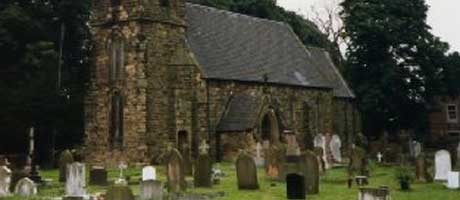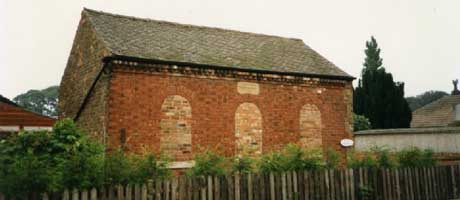
Amcotts (Amecotes)
The Trentside Village of Amcotts, with a population not exceeding 250, represents one of the small communities in the Isle of Axholme. Although nestling within a sheltered hook in the river it plays no part in river trade, the deep-water channel on the eastern side, directly opposite, providing the setting for numerous small wharves catering for an assortment of industries.
In former times the village constituted a hamlet within the confines of the parish of Althorpe but as Eastoft did with Crowle, so Amcotts became a parish in its own right, upon the consecration of a new church in the year 1853.
The village takes its name from the ancient family of Amcotts (or Amcoates), whose property it was for several hundred years, beginning with John de Amcotts, who was returned to Parliament as a member far the City of Lincoln, in the reign of Edward II. Entered on record in the Domesday Book, it is described as having "Soke in the Manor of Crowle and two carucates of land to be taxed. Land to one plough. Two sokemen and six villeins have there one plough".
Characteristically rural in appearance the outlying parish consists mainly of a number of scattered farms which, throughout the years, have been heavily warped to a degree of high productivity. Comparable with a number of other north Axholme villages, Amcotts possesses just the one shop doubling as a Post Office. Another distinguished family, linked by marriage to the Amcotts dynasty, lends its name to the only public house here, the Ingleby Arms.
The Manor House, the residence of Mr. W.R. Brown and family, commands a fine position centrally within the village, its extensive grounds forming a pleasing feature particularly when viewed across the roadway in the vicinity of St. Mark's Parish Church. The Old Rectory, opposite, purchased and extensively refurbished in later years, is the home of Mr. T.F. Belton, himself a descendant of an old Amcotts family of that name, and associated throughout the district with the farming industry.
One main access road, the B1392, connects both the north and south approaches to the village, the former continuing parallel with the Trent to Mere Dyke, on the parish boundary, whilst the latter, after leaving the village, loops westward before rejoining the river again a mile below Keadby. The loop indicates the changing pattern in the nature of the river when, in ancient times, two channels prevailed here. Upon settling to its present course, the western channel eventually silted up to form the fertile farmland so highly valued today.
In the mid-eighteenth century a surprising discovery was made on the peat moors surrounding Amcotts, of a body of a female who, it was reasoned, had perished on the marshy plain having unfortunately lost her way amid the desolate landscape. The skeleton was entire and the sandals the woman wore were almost perfectly preserved due no less to the nature of the moor water into which they had been submerged for several centuries.
The following account submitted to the Gentleman's Magazine recalls the incident thus : "Mr. Stovin (George Stovin, Esq., of Hirst in the parish of Belton) says that the labourer (the discoverer) had cut off the toe of one sandal with his spade when he made the discovery and that Mr. Stovin, on his arrival, soon found the other sandal, with the bones of the feet in it. He next found the skin and thigh bones, which measured eighteen inches, then the skin of the lower parts of the body, which distinguished it to be a woman, afterwards the skin of the arm, which, when the bones were shaken out, was like the top of a muff; likewise a hand, with the nails as fresh as when alive, though they shrunk on being exposed to the air. This was shown, with the bones of the fingers, to the Society of Antiquaries". In respect of the woman's sandals, it was opinioned that they dated from a time earlier than Edward IV, but not before the time of Edward I or Henry III, when shoes of this fashion first became worn.
That fateful afternoon, 1st June, 1974, will be forever etched in the minds of Amcotts residents. 0n this day the mighty explosion that engulfed the Nypro Chemical Works at Flixborough on the opposite bank of the river rocked this tiny community into a deep sense of shock and confusion. Though the fatalities, twenty eight in number, were restricted to the confines of the plant itself, injuries were received by many in Amcotts and the resultant damage from the blast to housing and property was widespread and extensive.
Today, years on, Amcotts has returned to its former tranquillity, with little outward evidence to remind one of the sorrow and destruction witnessed here by so many. Each has his own personal memories but few care to hold discourse on the events surrounding what otherwise would have been a peaceful Saturday afternoon.
Parish registration for Amcotts commenced in the year 1836. The Lincoln Archives hold baptism records up until 1930 and likewise with marriages, up to the year 1973. The remainder, including all burial records, remain with the incumbent, the Rev. J. Gibbons.